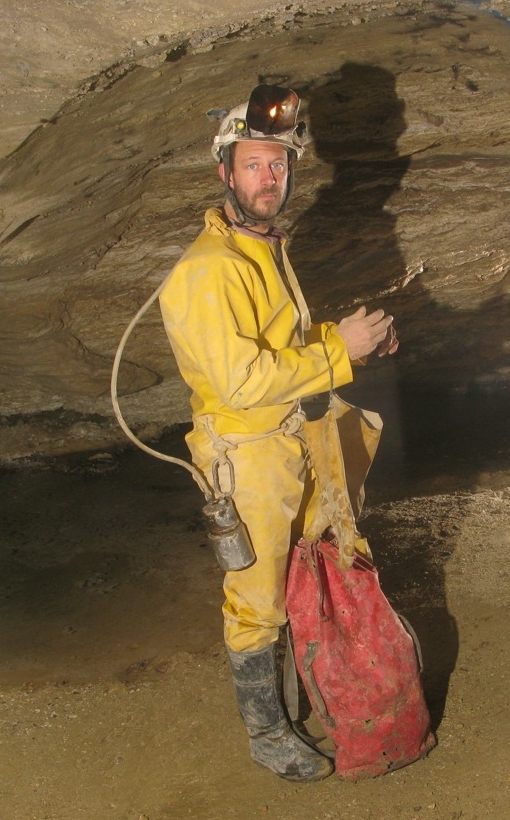
 (Photo by Chab Lathion)
 Actuality!!
For the Congress in Chambery (France), I edited a humoristic brochure
on speleogenesis - a collection of four texts that ar brilliantly written
and wonderful to read! They were such a success that several people were
proposing to translate these texts. Now we have two brochure sets:
One in german / french / italian / english. It can be bought
from me directly, or from the library of the Swiss speleological society.
The other one is russian / portutguese / spanish / baernduetsch! This
one is NOT printed, but can be downloaded free of charge:
Download
"Speleogenesis - the other view" in RU / ES / PT / bd
Working address
Ph. Haeuselmann
Swiss Institute for Speleology and Karst Studies
CH-2300
La Chaux-de-Fonds, Switzerland
Phone
+41 32 913 3533
Email
praezis<at>speleo.ch
Home address
Ph. Haeuselmann
Giebelweg 6
CH-3323 Baeriswil, Switzerland
Phone
+41 77 426 2390
See
my CV
See my publication
list
See my projects
Who am I?
I'm a german-speaking Swiss cititzen from Berne. Already as a kid, I got interested in nature and its related subjects, so I declared I wanted to be an "animal researcher". Farming and wood-cutting at my grandparents' and my Cousin's increased this wish, so I completed all the necessary schools. By then I came into contact with the world of caves, and at the very last day of inscription to the University, I decided to try geology instead of Forestry engineering (wich was closest to the living world). I soon became aware that the Earth is living, breathing and as fascinating as any other critter could be - only with timescales that are somewhat different. So, I never since regretted this choice.
Between 1991 and 1998 I was at the Institute of Geological Sciences of the University of Berne. In 1997, I finished my diploma in the field of Mineralogy and Petrology: Evolution and metamorphism of the rocks in Val Vergeletto (Ticino), under supervision of Martin Engi and Larryn Diamond. Many people find it strange that I was on the mineralogic side since I am also a keen caver! But right now, I consider myself as a "Earth scientist" rather than a Mineralogist or a Sedimentologist. This also has to do with my PhD: "Cave Genesis and its relationship to surface processes: Investigations in the Siebenhengste region", a work under supervision of Michel Monbaron and Pierre-Yves Jeannin. The thesis was carried out 1998-2002 at the University of Fribourg Switzerland.
Between 2002 and 2003 I was at my PostDoc stay with Darryl Granger at EAS, Purdue University, USA. Here, I dated the oldest phases of the Siebenhengste caves with cosmogenic isotopes. Thus, this work was in a certain sense the continuation of the PhD. The results are excellent, the oldest cave sediment is 4.4 Ma old!
Then, I was working for the BOKU Vienna (Markus Fiebig), and dated the classical Bavarian Deckenschotter, the famous Günz and Mindel glaciations. We plan to do some comprehensive terrace and cave dating in the Eastern Alps, in Austria and Slovenija, maybe also in Italy. The aim would be the temporal and spatial reconstruction of the geomorphological evolution during the last some million years.
Due to different unlucky reasons, my stay in Vienna ended prematurely.
That's why I returned to Switzerland and am now working at the Swiss Institute
for Speleology and Karst Studies. There are a lot of different tasks waiting
for me... and with my spare time I continue my research on cave genesis,
datings, and surface evolution.
Since 2007 I am again partly occupied
at BOKU Vienna for supervision of the cosmogenic lab and for lectures in
hydrogeology. So my university side continues...
As a summary, my work is divided into three main points:
Home to [Swiss
Speleological Society][SGH Bern]